How to Choose the Right Number of Nozzles for a Fuel Dispenser
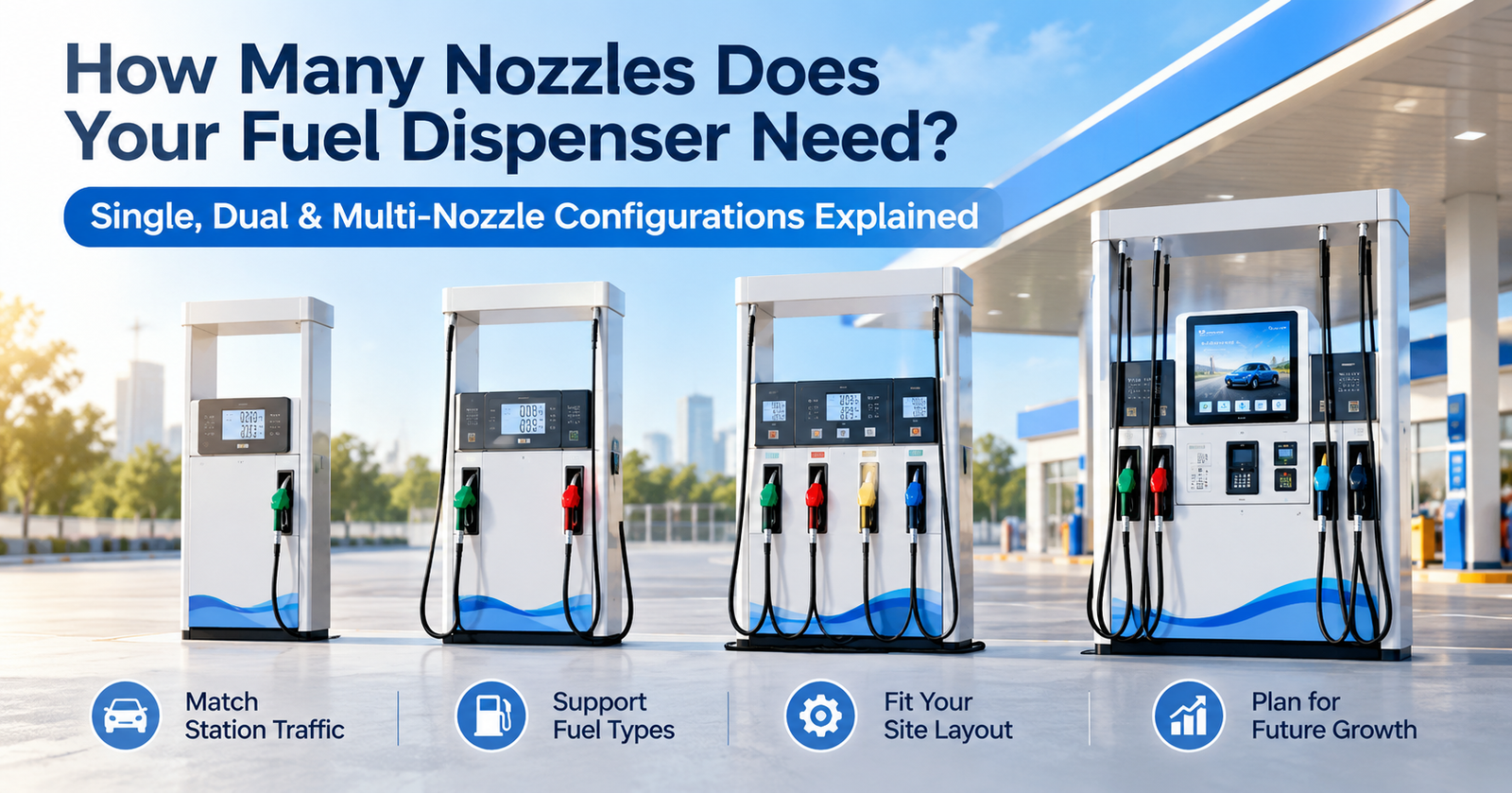
When selecting a fuel dispenser, buyers often begin by asking how many nozzles the machine should have.
One nozzle? Two? Four? Or a larger multi-nozzle configuration?
There is no universal answer.
The right nozzle quantity depends on how many vehicles the station serves, how many fuel products are offered, how the site is arranged and how busy the station becomes during peak periods.
Choosing too few nozzles can create waiting and restrict station operation. Choosing too many can increase cost and complexity without providing a meaningful benefit.
The aim is to match the dispenser configuration to the actual fueling demand.
Start With Real Vehicle Traffic
The first thing to look at is not the dispenser catalogue.
Look at the vehicles using the station.
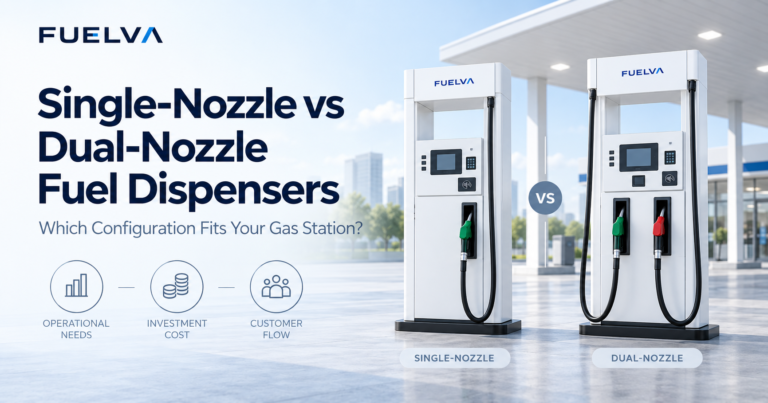
A small commercial station serving a limited number of vehicles may operate perfectly well with a single-nozzle dispenser.
A station with regular traffic or two fueling positions may benefit from a dual-nozzle configuration.
Busy retail stations, transport locations and larger commercial sites may need several nozzles to keep vehicles moving.
The important number is often not total daily traffic.
Peak-hour traffic matters more.
If twenty vehicles visit during the day but only one arrives at a time, the fueling requirement is very different from a site where several vehicles arrive within the same fifteen-minute period.
When Does a Single-Nozzle Dispenser Make Sense?
A single-nozzle dispenser is often suitable for straightforward fueling applications.
It may be a practical choice when:
- vehicle traffic is relatively light;
- only one fuel product is required;
- the site has one main fueling position;
- the operator wants simple daily operation;
- equipment cost needs to remain controlled.
A single-nozzle configuration can also work well for smaller commercial or private fueling locations where simultaneous fueling is uncommon.
In these applications, adding more nozzles may provide little practical advantage.
The Lifan Pro Single-Nozzle Fuel Dispenser is one example of a configuration aimed at conventional and cost-conscious fueling applications.
When Is a Dual-Nozzle Configuration Better?
Dual-nozzle dispensers offer more flexibility.
They may be useful when the station regularly serves more than one vehicle or needs two fueling positions.
A dual-nozzle configuration can also make sense when station traffic is not extremely heavy but the operator wants additional capacity during busy periods.
Typical considerations include:
- two vehicles may need fueling at the same time;
- the station wants more flexible vehicle positioning;
- future traffic growth is expected;
- the operator wants more capacity without moving to a large multi-nozzle system.
The Lisheng Dual-Nozzle Fuel Dispenser is suitable for conventional gas stations and commercial fueling applications that need this kind of additional flexibility.
What About Four-Nozzle Fuel Dispensers?
A four-nozzle configuration begins to make more sense when station traffic and fueling variety increase.
Four nozzles can provide several fueling positions or allow the dispenser to support a broader fueling arrangement.
This can be useful at busier retail stations where vehicle turnover matters.
However, a four-nozzle unit should not be selected simply because it appears more capable.
The site must have enough space and traffic to make use of those additional fueling positions.
If the surrounding forecourt cannot accommodate several vehicles conveniently, the extra nozzles may not improve overall station efficiency.
Multi-Nozzle Dispensers for Busy Stations
High-throughput stations may require multi-nozzle fuel dispensers.
These configurations are intended for applications where several vehicles may need fueling within a short period or where the station requires more fueling flexibility.
For these projects, nozzle quantity becomes part of a larger station design question.
Buyers should consider:
- number of fueling lanes;
- expected vehicle traffic;
- fuel product requirements;
- dispenser placement;
- vehicle access and exit;
- peak-hour demand.
A multi-nozzle dispenser can improve station capacity, but only when the site layout supports it.
Fuel Type Also Affects Nozzle Quantity
Nozzle quantity is not only about the number of vehicles.
It can also be related to the number of fuel products being handled.
A station offering several fuels may need different nozzle arrangements from a station selling only one product.
Before choosing the dispenser, clarify:
- how many fuel products will be sold;
- whether each product requires a dedicated nozzle;
- how customers will access the fueling positions;
- whether different fuels need to be available at the same dispenser.
This should be confirmed before quotation because it can directly affect the dispenser configuration.
Do Not Ignore Station Layout
It is easy to focus on the equipment and forget about the space around it.
A dispenser with several nozzles needs enough room for vehicles to approach, stop, refuel and leave without creating unnecessary congestion.
Consider:
- vehicle direction;
- distance between fueling positions;
- hose reach;
- dispenser location;
- nearby columns or structures;
- traffic flow through the site.
More nozzles do not help if vehicles cannot use them efficiently.
For new stations, it is worth discussing the layout before the dispenser configuration is finalized.
Peak Demand Is More Important Than Average Demand
Average traffic can be misleading.
A station may appear quiet for most of the day but become crowded during one or two short periods.
Commercial fleets are a good example.
Several vehicles may return to the same site at similar times, creating a short but intense fueling period.
Retail stations may experience the same effect during commuting hours or holiday traffic.
When deciding nozzle quantity, ask:
How many vehicles need fueling during the busiest part of the day?
That answer is usually more useful than the total number of vehicles served over 24 hours.
More Nozzles Also Mean More Complexity
Additional nozzles provide more capacity, but they can also increase equipment complexity.
More fueling positions may involve additional internal components, hoses, controls and maintenance points.
This does not mean buyers should avoid multi-nozzle dispensers.
It simply means the additional capacity should have a clear operational purpose.
If the station genuinely needs the extra fueling positions, the added complexity is justified.
If not, a simpler configuration may be more economical and easier to maintain.
Think About Future Growth
A station should not only be designed around its first few months of operation.
Traffic may increase.
The station may add new fuel products.
Commercial customers may grow.
For projects with clear expansion plans, it can make sense to leave some room for future capacity.
At the same time, there is no need to purchase the largest possible configuration simply because expansion might happen one day.
The better approach is to discuss realistic future demand with the supplier and choose a configuration that offers enough flexibility without unnecessary cost.
A Simple Nozzle Selection Guide
| Station Requirement | Typical Configuration to Consider |
|---|---|
| Light traffic, simple fueling | Single nozzle |
| Moderate traffic, more flexibility | Dual nozzle |
| Busier station or multiple fueling positions | Four-nozzle configuration |
| High-throughput or complex fueling requirements | Multi-nozzle configuration |
This is only a general guide.
The final decision should always consider vehicle traffic, fuel products, station layout and project requirements together.
Information to Prepare Before Choosing Nozzle Quantity
Before asking for a quotation, prepare:
- station type;
- expected daily vehicle traffic;
- peak-hour traffic;
- number of fuel products;
- preferred nozzle quantity;
- station layout;
- payment requirements;
- order quantity;
- destination country.
This information helps the supplier recommend a configuration that fits the actual station rather than simply offering the largest available model.
Choose Nozzle Quantity Based on the Station
There is no advantage in having more nozzles than the station can use.
At the same time, too few fueling positions can limit traffic flow and create waiting during busy periods.
A good fuel dispenser configuration balances capacity, site layout, operating requirements and future demand.
For smaller stations, a single or dual-nozzle dispenser may be enough.
For busier locations, four-nozzle or multi-nozzle solutions may provide better operating flexibility.
The right choice starts with understanding how the station will actually work.
Need Help Choosing a Fuel Dispenser Configuration?
FUELVA provides single-nozzle, dual-nozzle and multi-nozzle fuel dispenser solutions for different gas station and commercial fueling applications.
Send us your station type, expected traffic, fuel products, nozzle requirements, order quantity and destination country. We can review the project and help you select a practical dispenser configuration.