Single-Nozzle vs Dual-Nozzle Fuel Dispensers: Which One Should You Choose?
When buyers compare fuel dispensers, nozzle quantity is often one of the first questions.
A single-nozzle dispenser may look simpler, while a dual-nozzle model appears to offer more flexibility. However, the better choice depends on how the station actually operates.
A small station with moderate traffic does not always need more fueling positions. At the same time, choosing only one nozzle for a station that regularly handles several vehicles can create unnecessary waiting.
Rather than treating nozzle quantity as a specification to maximize, it is more useful to look at vehicle flow, station layout, fuel requirements and daily operation.
What Is a Single-Nozzle Fuel Dispenser?
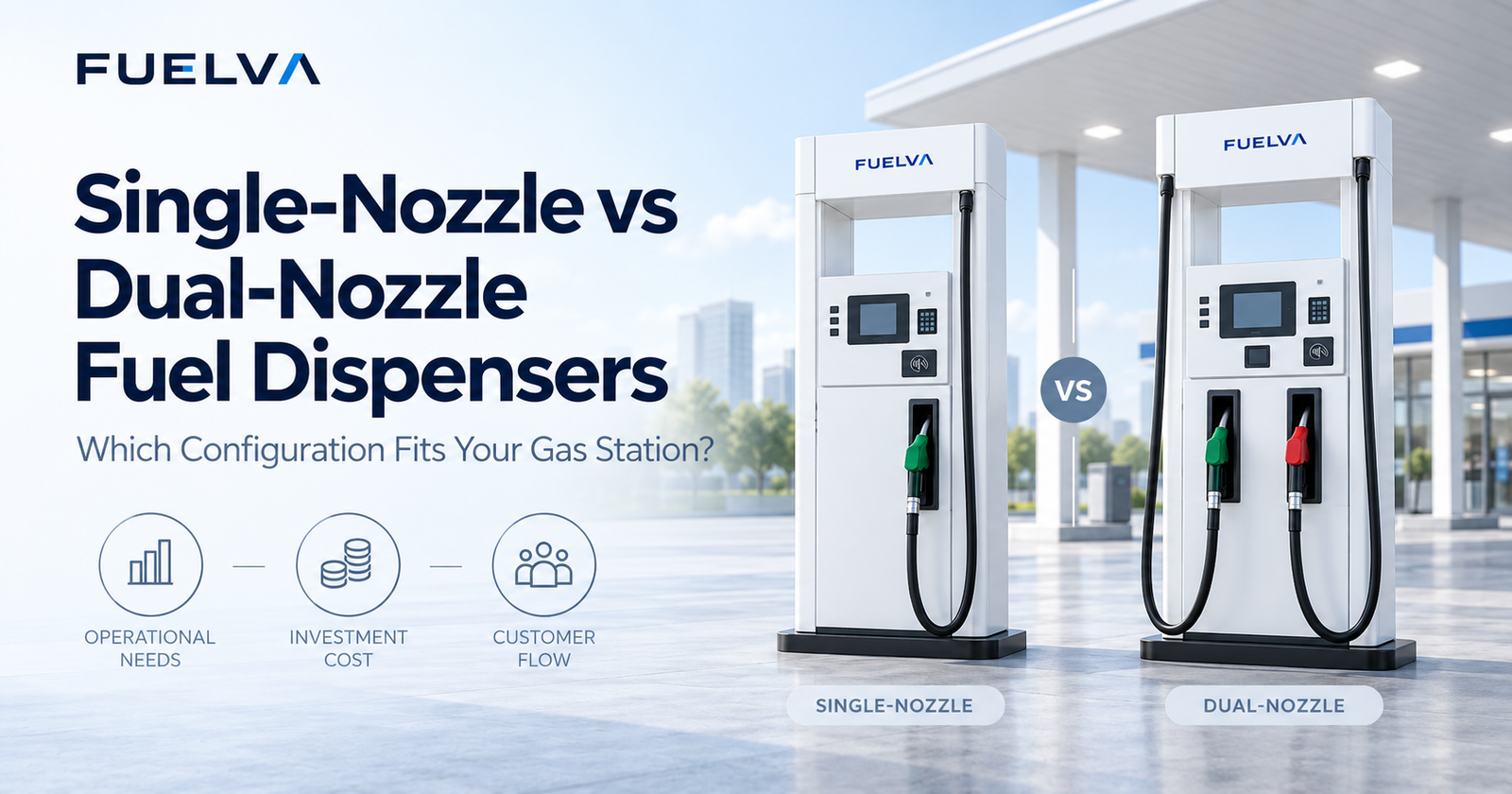
A single-nozzle fuel dispenser provides one fueling nozzle for each dispensing position or configured unit.
This type of dispenser is commonly considered for conventional gas stations and commercial fueling locations with relatively straightforward operating requirements.
Its main advantage is simplicity.
There are fewer fueling positions for staff to manage, and the equipment configuration can remain practical for locations where traffic is not especially heavy.
For buyers who want a straightforward solution without adding functions they may not need, a single-nozzle unit can be a sensible starting point.
FUELVA’s Lifan Pro Single-Nozzle Fuel Dispenser, for example, is positioned as an economical solution for conventional gas stations and commercial fueling applications.
Where Does a Single-Nozzle Dispenser Make Sense?
A single-nozzle configuration may be suitable when:
- vehicle traffic is moderate;
- only one fueling position is required at a time;
- the station has a relatively simple layout;
- operators prefer straightforward daily use;
- the project does not require several simultaneous fueling points;
- cost control is an important part of the project.
The important point is not that a single-nozzle dispenser is “basic.”
In the right station, it may simply be the most practical configuration.
Adding extra nozzles to a low-traffic site does not automatically improve the business. If those additional fueling positions are rarely used, the station may be paying for complexity it does not need.
What Is a Dual-Nozzle Fuel Dispenser?
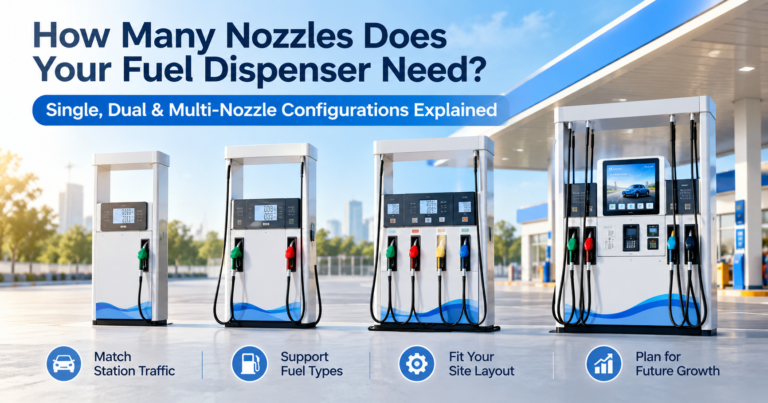
A dual-nozzle fuel dispenser provides two nozzles within the dispenser configuration.
Depending on the project, this can give operators more flexibility when arranging fueling positions or serving different operating requirements.
For a station with regular traffic, two nozzles may allow vehicles to be handled more conveniently than with a single fueling position.
A dual-nozzle design can also suit buyers who want additional operational flexibility without immediately moving to a larger multi-nozzle system.
FUELVA’s Lisheng Dual-Nozzle Fuel Dispenser is intended for conventional gas stations and commercial fueling applications where reliable operation and flexible configuration are important.
When Is a Dual-Nozzle Dispenser More Practical?
A dual-nozzle dispenser may be worth considering when:
- the station regularly serves more than one vehicle;
- traffic increases noticeably during certain periods;
- the operator wants more flexible fueling positions;
- the station layout can support simultaneous fueling;
- future traffic growth is expected;
- a single-nozzle configuration may become restrictive.
This does not mean every station should move to two nozzles.
The station should first have enough vehicle demand to make use of the additional capacity.
If most of the day only one vehicle is being fueled, the operational advantage may be limited.
The Biggest Difference Is Station Workflow
The most useful way to compare single-nozzle and dual-nozzle dispensers is to look at workflow.
Imagine two stations.
The first serves a steady but limited number of local vehicles. Drivers rarely arrive at the same time, and the operator values simple equipment that is easy to understand and maintain.
A single-nozzle dispenser may work perfectly well.
The second station sees several vehicles arriving during busy periods. Even if overall daily sales are not extremely high, vehicles sometimes have to wait for access to the dispenser.
In this case, a dual-nozzle configuration may improve station flow.
The decision is therefore less about the number printed on the product specification and more about how vehicles actually move through the site.
Consider Peak Traffic, Not Just Daily Volume
Daily fuel volume is useful, but it does not tell the whole story.
A station could have moderate total sales while still experiencing short periods of heavy traffic.
For example, fleet vehicles may return to a depot at similar times, or a commercial station may become busy during commuting periods.
Before deciding between single and dual nozzles, ask:
- How many vehicles arrive during the busiest hour?
- Do vehicles regularly wait for the dispenser?
- Does traffic arrive evenly throughout the day?
- Are several vehicle types being served?
- Is the station expected to grow?
Peak traffic often gives a clearer picture of nozzle requirements than total daily volume alone.
Station Layout Also Matters
More fueling positions only help when the site can use them properly.
The physical layout of the station should therefore be considered before choosing a dual-nozzle configuration.
Look at vehicle access, dispenser placement, traffic direction and available working space.
If two vehicles cannot approach and leave the fueling area conveniently, installing additional fueling capacity may not solve the real problem.
For new projects, discussing the station layout with the equipment supplier before finalizing the dispenser configuration can prevent unnecessary changes later.
Think About Fuel Type and Configuration
Nozzle quantity should also be considered together with the fuels being dispensed.
Some projects have a simple fueling requirement, while others may need different fuel arrangements or station configurations.
Before asking for a quotation, clarify:
- intended fuel type;
- required number of nozzles;
- expected vehicle traffic;
- station layout;
- payment requirements;
- commercial or fleet application;
- destination country.
This information helps the supplier understand whether a single-nozzle, dual-nozzle or larger multi-nozzle configuration makes the most sense.
Maintenance Should Not Be Ignored
A dispenser is used every day, so maintenance matters just as much as initial configuration.
A simpler system may be easier for some operators to manage, particularly at smaller sites.
A dual-nozzle dispenser can provide additional flexibility, but operators should still consider access for inspection, replacement parts and routine servicing.
The goal is not to avoid a more capable configuration. It is to choose equipment that staff can operate and maintain comfortably over time.
For overseas projects, spare-parts availability and technical communication should also be discussed before ordering.
What About Future Expansion?
This is where buyers sometimes make the wrong decision.
A station may currently need only one fueling position, but traffic could increase after the business becomes established.
In that situation, choosing equipment only for today’s minimum requirement may create limitations later.
On the other hand, buying a larger configuration “just in case” can add cost without a clear benefit.
A better approach is to discuss expected growth honestly.
If expansion is likely, ask whether the selected dispenser configuration offers enough flexibility for future requirements.
Single-Nozzle vs Dual-Nozzle: A Simple Comparison
| Consideration | Single-Nozzle | Dual-Nozzle |
|---|---|---|
| Station traffic | Better suited to lighter or straightforward demand | Better suited to more regular or simultaneous demand |
| Operation | Simple and practical | More flexible |
| Fueling positions | One main fueling position | Additional fueling flexibility |
| Typical use | Conventional stations and commercial fueling | Conventional stations with greater operating flexibility |
| Cost consideration | Often suitable for economy-focused projects | May justify higher configuration when traffic requires it |
| Future demand | Suitable where growth is limited or predictable | Useful where additional fueling demand is expected |
This table should be treated as a selection guide rather than a fixed rule.
Every station has different operating conditions.
Which One Should You Choose?
Choose a single-nozzle fuel dispenser when the station has straightforward fueling requirements, moderate traffic and no strong need for simultaneous fueling.
Consider a dual-nozzle fuel dispenser when regular vehicle traffic, station layout or future operating requirements make additional fueling flexibility useful.
Neither configuration is automatically better.
The right choice is the one that matches the station’s actual operating pattern without adding unnecessary complexity.
For many buyers, the best decision comes after comparing three things:
current traffic, peak traffic and expected future demand.
Those three factors usually provide a much clearer answer than comparing nozzle quantity alone.
Need Help Comparing Fuel Dispenser Configurations?
FUELVA supplies single-nozzle, dual-nozzle, smart and multi-nozzle fuel dispenser solutions for different gas station and commercial fueling applications.
Send us your station type, expected traffic, nozzle quantity, payment requirements, order quantity and destination country. We can review the project requirements and help you identify a practical dispenser configuration.